


Table of Contents
- What You'll Need Before You Start Measuring
- How to Measure Bust, Waist, and Hips Step by Step
- Measuring Tape Tips for Clothing That Actually Fits
- How to Choose Dress Size Online Using Size Charts
- Measuring for Specific Dress Styles and Fabrics
- Common Mistakes to Avoid When Measuring Yourself
- Conclusion
- Frequently Asked Questions
Last Updated: September 15, 2026
What You'll Need Before You Start Measuring
A soft measuring tape is the single tool that matters most, and it costs less than a coffee. You need a flexible tape at least 60 inches long, a mirror you can stand in front of, and something to write your numbers on. That's the full kit.
Skip the stiff metal tape from the toolbox. It won't bend around your bust or hips, and the numbers will be wrong every time.
Learning how to measure yourself for online dresses, and knowing exactly when to measure yourself, solves that problem before it starts.
Here's what to gather before you begin:
- Soft measuring tape (fabric or vinyl, the kind sold for sewing)
- A full-length mirror so you can check tape placement without twisting
- Fitted clothing like a thin camisole and leggings, not bulky layers
- A pen and paper or a notes app
- A trusted friend if you can find one, though self-measurement works fine solo
Wear a well-fitting bra. A sports bra flattens the bust and skews the number. A padded push-up adds volume that won't match the dress. Choose the bra you'd actually wear with the dress you're buying.
How to Measure Bust, Waist, and Hips Step by Step
These three numbers decide your dress size on nearly every size chart. Get them right and you eliminate most fit guesswork.
Stand tall, breathe normally, and keep the tape parallel to the floor. Snug, not tight. You should be able to slip one finger under the tape.
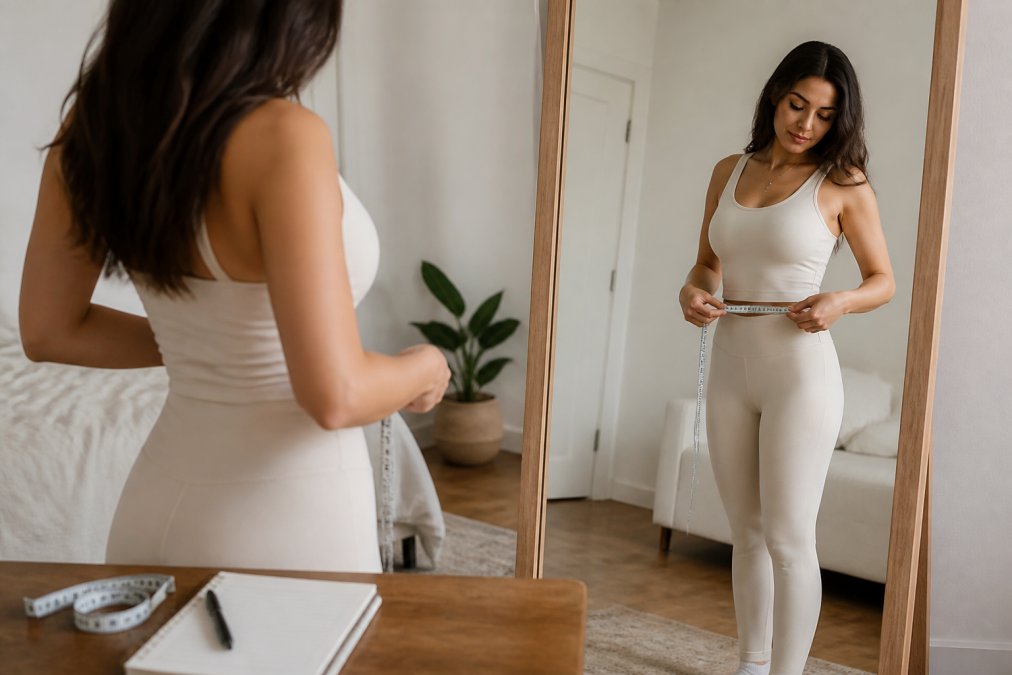
Measuring Your Bust at the Fullest Point
The ideal bust measurement is taken at the fullest part of your chest, which is usually level with the apex of bust, not the bra band.
Wrap the tape around your back at the same height, keeping it horizontal. Don't pull it tight enough to compress tissue. Arms should rest at your sides, not lifted, because raising them changes the number.
Write down the figure immediately. Most people lose track after measuring three areas.
Finding Your Natural Waistline
Your natural waist sits at the slimmest area of your torso, typically just above the belly button and below the rib cage.
Bend sideways. The crease that forms is your natural waist. Measure there. Keep the tape horizontal all the way around, and breathe out normally before you read the number. Sucking in gives you a size that won't match reality.
Getting Your Hip Measurement Right
The hip measurement goes around the fullest part of your hips and rear, usually 7 to 9 inches below your natural waist.
Stand with feet together. The tape should pass over the widest point of your seat and close smoothly at the front. If the tape dips or rides up at the back, start again.
| Measurement | Where to Place the Tape | Keep In Mind |
|---|---|---|
| Bust | Fullest part of chest, level with apex | Arms down, tape horizontal |
| Waist | Slimmest area, above belly button | Breathe out, don't suck in |
| Hips | Fullest part of seat, 7-9 inches below waist | Feet together, tape level |
Measuring Tape Tips for Clothing That Actually Fits
Consistency beats precision. The same tape tension every time gives you numbers that work together, even if each one is a hair off.
Check your tape before you trust it. Hold it against a ruler for the first 10 inches. Cheap tapes stretch over time, and a stretched tape quietly inflates every measurement.
A few habits that separate accurate measurements from frustrating ones:
- Measure in front of a mirror so you can spot a tilted tape
- Keep the tape snug but never indented into skin
- Take each measurement twice and average the two
- Record numbers in inches, since most size charts use inches
- Re-measure every few months, because bodies shift
Tape tension is where most people go wrong. Pull too hard and you'll size down into a dress that won't zip. Leave it loose and you'll size up into something that hangs.
How to Choose Dress Size Online Using Size Charts
Size charts vary by brand, and that's the point most shoppers miss. A size 8 at one label is a size 10 at another. Your measurements are the constant; the size label is not.
Use your largest measurement to pick the size, then plan alterations if needed. If your bust says size 8 but your hips say size 10, order the 10 and have the waist taken in. Letting a dress out is far harder than taking it in, a seam only has so much fabric folded inside it, and structured fabrics like satin or crepe usually have none to spare.
Here's how to read a size chart without guessing:
- Find the brand's own chart, not a generic one pulled from a search result
- Match your bust, waist, and hips to the closest row, not to the letter you wore last season
- When you fall between sizes, size up
- Check the chart's unit (inches vs. centimeters) before comparing
- Read the fit notes, since some dresses run small by design
Inches vs. Centimeters: Don't Mix Them Up
Most U.S. brands publish charts in inches, but plenty of imported labels list centimeters only. One inch equals 2.54 centimeters, so a 28-inch waist is about 71 cm (SI Units - Length | NIST). If you measured in inches and the chart is in centimeters, convert before you compare, a 28 next to a 71 looks like a massive gap until you do the math. Write your three numbers in both units once, and you'll never have to convert again.
Why the Same Number Means Different Things Across Labels
U.S. women's sizing has no single enforced standard. The old voluntary commercial standards that once tied a size number to specific body measurements were withdrawn decades ago, which is why a size 8 can measure differently from brand to brand (Body Dimensions for Apparel). U.K. and E.U. charts use entirely different numbering systems on top of that, so a U.S. 8 does not map cleanly onto a U.K. 12 or an E.U. 38, and conversion charts published by different retailers often disagree with each other. The practical takeaway: when a brand lists both a size label and a measurement range, trust the measurement range every time.
| Your Measurement | What to Do |
|---|---|
| Falls inside one row on bust, waist, and hips | Order that size |
| Falls in two different rows | Order the larger size and plan to alter |
| Falls between two sizes in the same row | Size up |
| Chart is in centimeters, you measured in inches | Multiply inches by 2.54 first |
This is where how to choose dress size online gets simpler than people expect. Your three numbers do the work.
For a deeper look at matching dresses to your shape and preferences, the [5-Day Dress Confidence(/products/the-5-day-dress-confidence-reset) Reset course from After Nine Collection | afterninecollection.com] walks through fit, fabric, and color in short daily lessons.
Measuring for Specific Dress Styles and Fabrics
Fabric changes everything. A stretch jersey forgives a half-inch error. A structured satin or crepe does not. The fix isn't to measure differently for every dress, it's to know which way the fabric will move once it's on your body, and to record your numbers with that in mind.
Knit vs. Woven: The Rule That Actually Matters
Dresses fall into two broad construction families, and they behave differently against your measurements.
- Knits (jersey, ponte, ribbed modal) stretch.
How Cut Changes the Number You Record
A Note on Non-Standard Proportions
Your body measurements don't change between brands. The size label does. Always shop by your numbers, not by the size you wore last season, and adjust your final pick up or down based on whether the fabric stretches.
Common Mistakes to Avoid When Measuring Yourself
Other errors show up again and again:
Conclusion
Frequently Asked Questions
How do you measure yourself for online clothing?
Use a soft measuring tape and wear fitted clothing or undergarments. Measure your bust at the fullest part, your natural waist at the slimmest area above your belly button, and your hips at the fullest point. Keep the tape level and snug but not tight. Write each measurement down and compare them to the brand's size chart before ordering.
Should I measure myself in inches or centimeters for online shopping?
Check the brand's size chart first. Most U.S.-based online dress retailers list measurements in inches, but some international brands use centimeters. If the chart uses a different unit than your tape, convert before comparing. Knowing both your inch and centimeter measurements helps when shopping across different retailers.
What should I wear while taking my body measurements?
Wear thin, fitted clothing or your usual undergarments. Bulky sweaters, robes, or loose fabrics add inches and throw off your numbers. Stand naturally with good posture and keep your feet together. If you plan to wear shapewear with the dress, measure while wearing it for the most accurate fit.
How do I measure my waist correctly for a fitted dress?
Find your natural waist by bending slightly to one side. The crease that forms is your natural waistline, usually just above the belly button. Wrap the tape around that point, keeping it parallel to the floor. Breathe normally and don't suck in. For fitted dresses, this measurement matters most because the waistline determines whether the dress sits smoothly.